
Who Benefits When 200 Economists Say the Sky Is Falling
July 13, 2026
DCXpress News
Independent Editorial
July 13, 2026
THE UNRAVELING | Opinion & Analysis
High Beams: Who Benefits When 200 Economists Say the Sky Is Falling
By Francis T. Bradford | Founder & Editor, DCXpress News
This week, more than 200 economists, executives, and researchers — including over a dozen Nobel laureates — signed a joint statement warning that artificial intelligence could reshape the economy faster and harder than the Industrial Revolution. It's called "We Must Act Now." It's 88 words long. You can read the whole thing in about fifteen seconds:
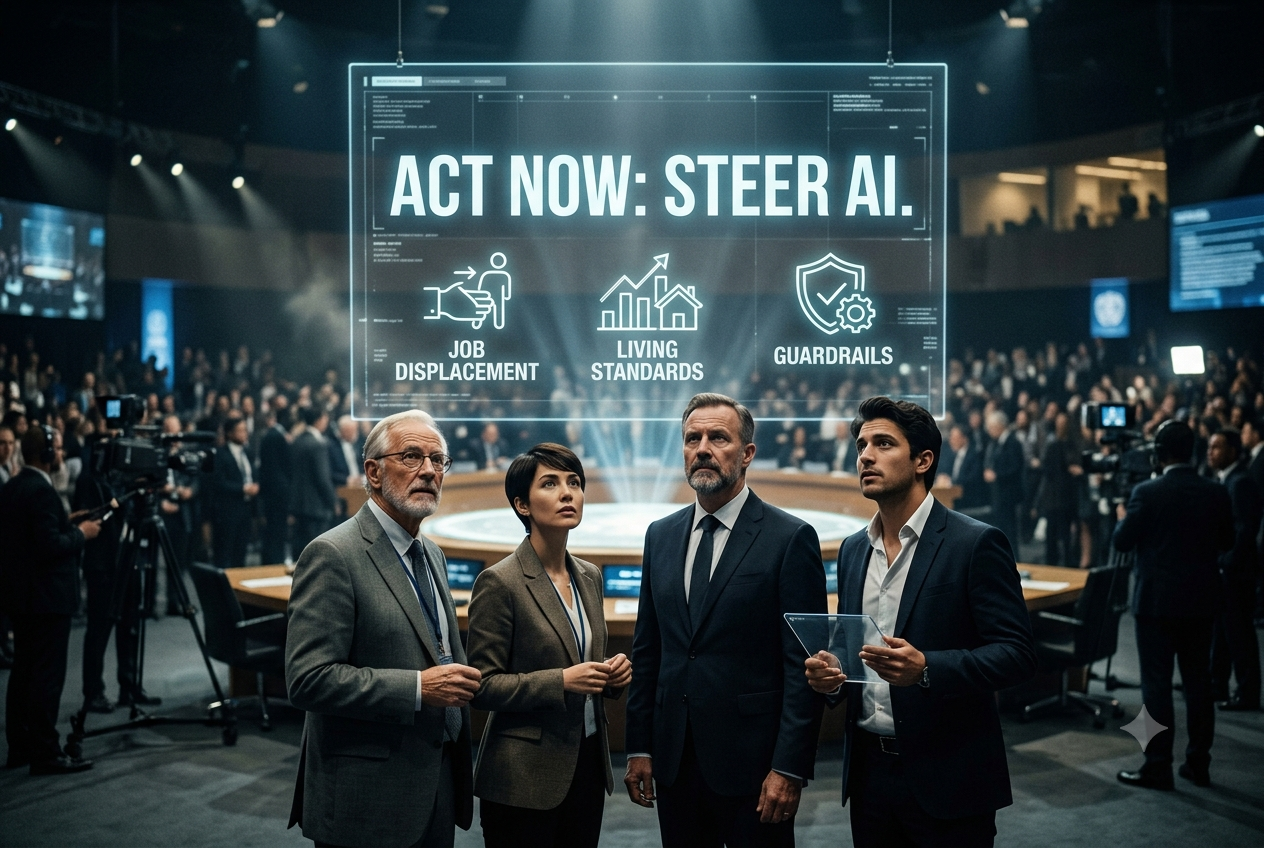
AI may become radically more powerful over the next 10 years. This could drive an unprecedented transformation of our economy, larger than the Industrial Revolution, but unfolding over a vastly shorter time frame. It could bring risks, including large-scale job displacement, as well as opportunities such as major gains in living standards. Economists, policymakers and technology leaders must act now to understand the economics of transformative AI and to build the incentives, guardrails, and institutions needed to steer AI in a direction that complements humans and benefits society.
Read it again. Notice what's missing. No policy. No mechanism. No number. No name attached to a single cause. Just a warning, wrapped in the passive voice, aimed at somebody else to fix.
I want to be careful here, because this isn't a piece about calling anybody names. Some of the people who signed this letter have spent careers being the skeptics in the room. Daron Acemoglu and Simon Johnson — both MIT professors, both 2024 Nobel laureates in economics — have publicly doubted the more breathless AI-doom predictions for years. Acemoglu still says he hasn't fully abandoned that doubt. When people like that put their name on something, it means more than when the usual chorus does, because they're spending real credibility to say it.
But look at who else signed. Jack Clark, a co-founder of Anthropic. Jeff Dean, who leads AI work at Google. Sarah Friar, OpenAI's chief financial officer. These aren't outside observers warning about a storm on the horizon. These are people whose companies are building the storm, on purpose, on a timeline they control, for profit they're already collecting. Dario Amodei, Anthropic's own CEO, has predicted AI could wipe out half of entry-level white-collar jobs within five years — and Anthropic keeps shipping. That's not a contradiction anyone's hiding. It's just how the industry has operated for years now: build as fast as possible, warn everybody about what you're building, keep building.
Here's the timing that ought to bother you as much as it bothers me. This letter isn't a warning before the fact. White-collar payrolls have been contracting for dozens of consecutive months now — a stretch one former Glassdoor chief economist has called without precedent outside of an actual recession. The unemployment rate looks calm on paper, but the slack is showing up as people quietly leaving the workforce, not as headline layoffs. In other words: the letter arrived after the data already told the story. It's not prophecy. It's an acknowledgment, timed for a moment when the acknowledgment costs nothing and changes nothing.
And that's the part worth sitting with. If 200-plus of the sharpest economic minds in the country wanted to actually prevent mass job displacement — not just warn about it, prevent it — they know how to write that document. Retraining pipelines with real funding behind them. Procurement rules that require a human in the loop. Tax policy that stops rewarding companies for cutting headcount. A labor-share requirement tied to productivity gains. None of that made it into 88 words. What made it in was "guardrails and institutions," aimed at policymakers, with zero commitment from the signatories' own employers to slow down, share the gains, or change course.
I keep coming back to a picture: somebody's driving toward you at night with their high beams on. You can't see the road in front of your own feet because the light in your eyes is so much bigger than anything else. Beware the robots, they say. Wear your gloves. Wear your thinking cap. Something enormous and impersonal is coming for your job, and there's nothing anybody in particular did to cause it — it just may become "radically more powerful," like weather. That framing does real work. It moves the blame off any specific company or decision and onto the technology itself, as if the technology built itself and deployed itself and nobody at any boardroom table ever voted to ship it anyway. Once displacement gets treated as an act of nature instead of a series of choices, it gets a lot harder for regular people to organize against anything. You can't picket a weather pattern.
None of this means the underlying warning is wrong. The labor market data is real. The job losses are real. The speed is probably real too. My problem isn't with the warning — it's with the shape of it. A statement with this much star power and this little specificity isn't built to change what happens next. It's built to be pointed to later, so that when the disruption lands the way Amodei and Acemoglu both say it might, somebody can say: we told you. Telling you isn't the same as building you a way through it.
If the people who signed this letter — especially the ones running the labs — actually believe what it says, the tell will be in what they do with their own capital and their own companies over the next few months, not in what they signed this week. Watch that instead of the headlines. That's usually where the real signal is.
It's going to rain. That much I believe. The question this letter never answers is who's supposed to be holding the umbrella — and who decided, a long time ago, that it wasn't going to be them.
Francis T. Bradford is the founder, editor, and publisher of DCXpress News (dcxpress.news),
an independent editorial platform covering surveillance, AI policy, and political economy.
This piece is part of the ongoing series “The Unraveling.”
Sources & Further Reading
Read the letter Eric Schmidt, Reid Hoffman, and top economists signed warning about AI's threat to jobs — AOL/Business Insider: https://www.aol.com/articles/read-letter-eric-schmidt-reid-125618000.html
Economists are coming around to the idea that AI really is killing jobs — Quartz: https://qz.com/economists-ai-job-displacement-industrial-revolution-statement-071326
AI Job Impact: Read the Letter From Economists and Executives at OpenAI, Anthropic, Google — Business Insider: https://www.businessinsider.com/ai-job-impact-read-letter-economists-executives-openai-anthropic-google-2026-7
Economists Warn AI Poses Threat to Jobs — The New York Times: https://www.nytimes.com/2026/07/13/business/economists-ai-threat-jobs.html
"We Must Act Now" — the full statement, Stanford Digital Economy Lab: https://www.wemustactnow.ai/
Independent Editorial
July 13, 2026
THE UNRAVELING | Opinion & Analysis
High Beams: Who Benefits When 200 Economists Say the Sky Is Falling
By Francis T. Bradford | Founder & Editor, DCXpress News
This week, more than 200 economists, executives, and researchers — including over a dozen Nobel laureates — signed a joint statement warning that artificial intelligence could reshape the economy faster and harder than the Industrial Revolution. It's called "We Must Act Now." It's 88 words long. You can read the whole thing in about fifteen seconds:
AI may become radically more powerful over the next 10 years. This could drive an unprecedented transformation of our economy, larger than the Industrial Revolution, but unfolding over a vastly shorter time frame. It could bring risks, including large-scale job displacement, as well as opportunities such as major gains in living standards. Economists, policymakers and technology leaders must act now to understand the economics of transformative AI and to build the incentives, guardrails, and institutions needed to steer AI in a direction that complements humans and benefits society.
Read it again. Notice what's missing. No policy. No mechanism. No number. No name attached to a single cause. Just a warning, wrapped in the passive voice, aimed at somebody else to fix.
I want to be careful here, because this isn't a piece about calling anybody names. Some of the people who signed this letter have spent careers being the skeptics in the room. Daron Acemoglu and Simon Johnson — both MIT professors, both 2024 Nobel laureates in economics — have publicly doubted the more breathless AI-doom predictions for years. Acemoglu still says he hasn't fully abandoned that doubt. When people like that put their name on something, it means more than when the usual chorus does, because they're spending real credibility to say it.
But look at who else signed. Jack Clark, a co-founder of Anthropic. Jeff Dean, who leads AI work at Google. Sarah Friar, OpenAI's chief financial officer. These aren't outside observers warning about a storm on the horizon. These are people whose companies are building the storm, on purpose, on a timeline they control, for profit they're already collecting. Dario Amodei, Anthropic's own CEO, has predicted AI could wipe out half of entry-level white-collar jobs within five years — and Anthropic keeps shipping. That's not a contradiction anyone's hiding. It's just how the industry has operated for years now: build as fast as possible, warn everybody about what you're building, keep building.
Here's the timing that ought to bother you as much as it bothers me. This letter isn't a warning before the fact. White-collar payrolls have been contracting for dozens of consecutive months now — a stretch one former Glassdoor chief economist has called without precedent outside of an actual recession. The unemployment rate looks calm on paper, but the slack is showing up as people quietly leaving the workforce, not as headline layoffs. In other words: the letter arrived after the data already told the story. It's not prophecy. It's an acknowledgment, timed for a moment when the acknowledgment costs nothing and changes nothing.
And that's the part worth sitting with. If 200-plus of the sharpest economic minds in the country wanted to actually prevent mass job displacement — not just warn about it, prevent it — they know how to write that document. Retraining pipelines with real funding behind them. Procurement rules that require a human in the loop. Tax policy that stops rewarding companies for cutting headcount. A labor-share requirement tied to productivity gains. None of that made it into 88 words. What made it in was "guardrails and institutions," aimed at policymakers, with zero commitment from the signatories' own employers to slow down, share the gains, or change course.
I keep coming back to a picture: somebody's driving toward you at night with their high beams on. You can't see the road in front of your own feet because the light in your eyes is so much bigger than anything else. Beware the robots, they say. Wear your gloves. Wear your thinking cap. Something enormous and impersonal is coming for your job, and there's nothing anybody in particular did to cause it — it just may become "radically more powerful," like weather. That framing does real work. It moves the blame off any specific company or decision and onto the technology itself, as if the technology built itself and deployed itself and nobody at any boardroom table ever voted to ship it anyway. Once displacement gets treated as an act of nature instead of a series of choices, it gets a lot harder for regular people to organize against anything. You can't picket a weather pattern.
None of this means the underlying warning is wrong. The labor market data is real. The job losses are real. The speed is probably real too. My problem isn't with the warning — it's with the shape of it. A statement with this much star power and this little specificity isn't built to change what happens next. It's built to be pointed to later, so that when the disruption lands the way Amodei and Acemoglu both say it might, somebody can say: we told you. Telling you isn't the same as building you a way through it.
If the people who signed this letter — especially the ones running the labs — actually believe what it says, the tell will be in what they do with their own capital and their own companies over the next few months, not in what they signed this week. Watch that instead of the headlines. That's usually where the real signal is.
It's going to rain. That much I believe. The question this letter never answers is who's supposed to be holding the umbrella — and who decided, a long time ago, that it wasn't going to be them.
Francis T. Bradford is the founder, editor, and publisher of DCXpress News (dcxpress.news),
an independent editorial platform covering surveillance, AI policy, and political economy.
This piece is part of the ongoing series “The Unraveling.”
Sources & Further Reading
Read the letter Eric Schmidt, Reid Hoffman, and top economists signed warning about AI's threat to jobs — AOL/Business Insider: https://www.aol.com/articles/read-letter-eric-schmidt-reid-125618000.html
Economists are coming around to the idea that AI really is killing jobs — Quartz: https://qz.com/economists-ai-job-displacement-industrial-revolution-statement-071326
AI Job Impact: Read the Letter From Economists and Executives at OpenAI, Anthropic, Google — Business Insider: https://www.businessinsider.com/ai-job-impact-read-letter-economists-executives-openai-anthropic-google-2026-7
Economists Warn AI Poses Threat to Jobs — The New York Times: https://www.nytimes.com/2026/07/13/business/economists-ai-threat-jobs.html
"We Must Act Now" — the full statement, Stanford Digital Economy Lab: https://www.wemustactnow.ai/
Login or Register to leave a comment.
Comments
No comments yet.