
The New Company Store: AI, Automated Labor, and the Theft of the American Wage
May 27, 2026
DCXpress News
Independent Editorial
May 27, 2026
THE UNRAVELING | Opinion & Analysis
When machines take the jobs, who owns the wealth they generate — and who pays the price?
By Francis T. Bradford | Founder & Editor, DCXpress News
This week, Sam Altman of OpenAI stood before a banking conference in Sydney and told the world he was “delighted” that the jobs apocalypse he once predicted had not arrived on schedule. At almost the same moment, Dario Amodei of Anthropic was standing by his warning that artificial intelligence will eliminate up to half of all entry-level white-collar jobs within five years — and that unemployment could reach 20 percent. Two men. Two companies building the same technology. Two entirely different stories for public consumption.
Neither of them is telling you the whole truth. And neither of them has to live with what’s coming.
The rest of us do.
We Have Seen This Before
History does not repeat itself exactly. But it rhymes with enough precision that if you have read it carefully, you can hear the next verse before it arrives.
The 1920s were a decade of miraculous productivity gains. Electrification. The assembly line. Mechanization of agriculture. Wealth was generated at a scale the country had never seen. Almost none of it reached the people whose labor built the system. It concentrated at the top with a speed and totality that the existing institutions had no framework to address. By 1929, the structural tension had nowhere left to go.
We are running that experiment again. Except this time the displacement curve is not measured in decades — it is measured in product release cycles. And the people building the machinery also happen to be building the surveillance infrastructure, the policy apparatus, and the political relationships that will determine how the correction, if it comes, gets managed.
That is a much tighter loop than Standard Oil ever operated.
The Alaska Dividend and the Obligation of Extraction
Alaska has a Permanent Fund. The logic is simple: the oil belongs to the people of Alaska. When you extract it for private profit, you owe the people whose resource you took a share of what you made.
The labor market belongs to society in exactly the same way. When a corporation replaces ten workers with an algorithm, it has extracted something — wages, purchasing power, economic participation — from the community those workers lived in. The factory still stands. The goods still move. The profit still accumulates. It simply stops flowing downward.
Automated labor is mechanized slavery with a balance sheet. The machine does not eat. It does not need healthcare. It does not spend money at the local diner or put its children through school. It generates pure margin for the entity that owns it, while the community that once employed human beings to do that work absorbs the cost of their displacement in silence.
A collective tax on automated labor is not a radical idea. It is the Alaska Permanent Fund applied to the economy OpenAI and Anthropic are building right now. Notably, OpenAI itself called for exactly this in a 13-page policy document earlier this year — automated labor taxes, a national wealth fund, a 32-hour work week. The fact that they proposed it tells you they already know the damage is coming. The question is who controls the remedy.
Working ‘Alongside’ AI Is Not a Job. It Is a Transition Narrative.
Every wave of automation has arrived with the same reassurance: the machines will create new jobs. Retrain. Adapt. The economy will absorb you.
Sometimes that was partially true — over decades, with enormous disruption in between, borne almost entirely by the people at the bottom of the wage scale. This time the displacement curve is near-vertical. There is no retraining runway long enough when the new economy is being deliberately engineered to not need you.
The phrase “working alongside AI” is language management. It is designed to soften the transition period until the transition is complete and the language no longer matters. The 32-hour work week proposal is the same thing dressed as progress. If AI is performing the labor, who exactly is working 32 hours? A shrinking technical class managing the systems. Everyone else is not working 32 hours. They are working zero.
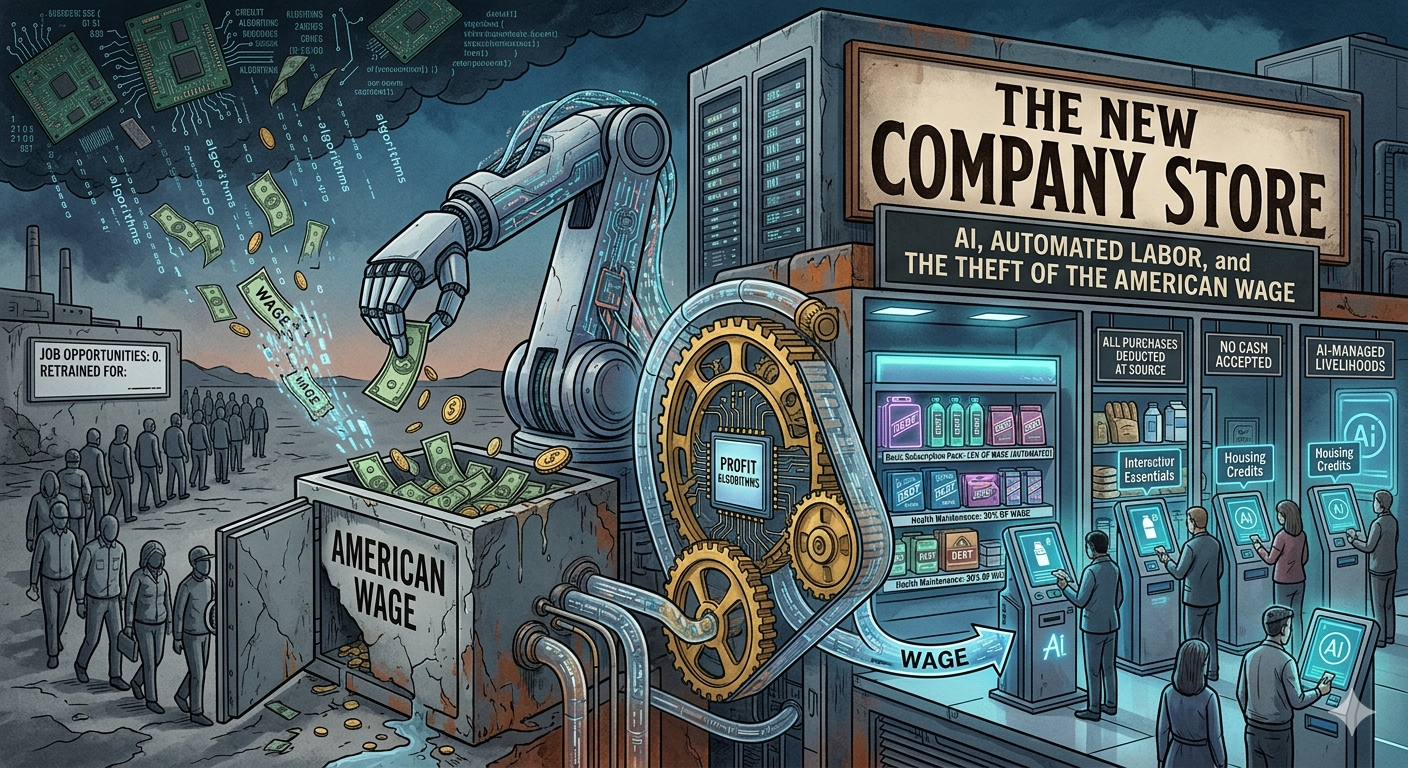
The Company Store, Digitized
There is a logical endpoint to this trajectory that the policy conversation is not yet willing to name plainly. If automated labor displaces broad employment, some form of universal payment must replace wages — or the consumer base that the same corporations depend on collapses. They need us poor enough to be dependent and solvent enough to keep buying.
The infrastructure for that payment is already being assembled. The elimination of cash. Centralized digital payment systems. Government-issued benefit cards tied to individual identity. Each piece is presented as efficiency or fraud prevention. What it actually constructs is total financial surveillance and control. You can freeze a card. You can restrict what it purchases. You can set an expiration on balances. Cash cannot be managed that way. Which is exactly why cash is going away.
The classic company store paid workers in scrip — currency that only worked at the company store, at prices the company set, ensuring workers were permanently indebted and permanently controlled. A Universal Basic Income administered through a corporate-influenced federal payment card, set at a level determined by the same political apparatus those corporations fund, is the same mechanism at national scale. Just enough to prevent revolt. Never enough to escape.
The Pitfalls Are Real. The Benefits Are Conditional.
In the interest of completeness, the case for AI-driven automation is not without merit on its own terms. Genuine productivity gains. Advances in medicine, materials science, and logistics that could improve quality of life across the board. The elimination of dangerous, degrading, repetitive work is not inherently a bad thing — if the surplus it generates is broadly shared.
That conditional is doing enormous work in that sentence.
The historical record is not encouraging. Productivity gains have been broadly shared in American history exactly twice: the post-war expansion of 1945 to 1975, underwritten by strong unions, the GI Bill, progressive taxation, and deliberate policy intervention. And never since. Every other wave of technological productivity has followed the same pattern — gains to capital, costs to labor, policy corrections that arrived too late and were systematically dismantled once the immediate pressure subsided.
The correction mechanisms that forced previous redistributions — strong unions, independent media, aggressive antitrust enforcement, a functioning regulatory state — have been methodically weakened in advance of this wave. That is not coincidence.
The Question You Should Be Asking
Not “Will AI take my job?” That question has already been answered for a significant portion of the workforce, and the honest answer is yes — on a timeline measured in years, not generations.
The question that matters is this: who controls the off switch on your payment card, and what would you have to do — or stop doing — to keep it from being flipped?
When your wages came from an employer, you had options. You could quit. You could organize. You could find another employer. The power was asymmetric but not absolute. When your income comes from a government card administered by a system shaped by the same corporations that automated your job away, the leverage is gone. Dissent has a price. Compliance has a reward. The architecture enforces itself.
This is not speculation about a distant future. The infrastructure is being built now. The policy framework is being drafted now. The public debate is being managed now — by people with a direct financial interest in how it resolves.
The 1930s Did Not Have to End the Way They Did
The Gilded Age did not end because the robber barons had a change of heart. It ended because the pressure became ungovernable — unions, muckrakers, trust-busting, and eventually a New Deal that the people in power spent the next half-century trying to dismantle.
Every correction came after enormous suffering. Every correction was fought by the people who benefited from the arrangement it replaced. And every correction, once won, was treated as a temporary inconvenience by the interests it constrained.
We are early in that cycle. The difference this time is speed. The AI displacement curve, the surveillance infrastructure, and the political consolidation are all accelerating simultaneously. The window for the kind of organized response that produced the New Deal is narrower than it has ever been — and it is closing.
Sam Altman says he is delighted the apocalypse has not arrived on schedule. He is right that the unemployment numbers have not moved yet. What the numbers do not show is the entry-level hiring freeze, the wage compression, the gig economy expansion absorbing displaced workers at subsistence rates, and the systematic removal of the institutional safeguards that would slow what comes next.
The oil is flowing. The dividend has not been paid. And the company store is under construction.
If you cannot see it, you have not read the history. Or someone very powerful has made sure the history is harder to find.
Francis T. Bradford is the founder, editor, and publisher of DCXpress News (dcxpress.news),
an independent editorial platform covering surveillance, AI policy, and political economy.
This piece is part of the ongoing series “The Unraveling.”
Login or Register to leave a comment.
Comments
No comments yet.