
Later, Sucker: How America Is Discarding Its Workers in the Age of AI
March 10, 2026
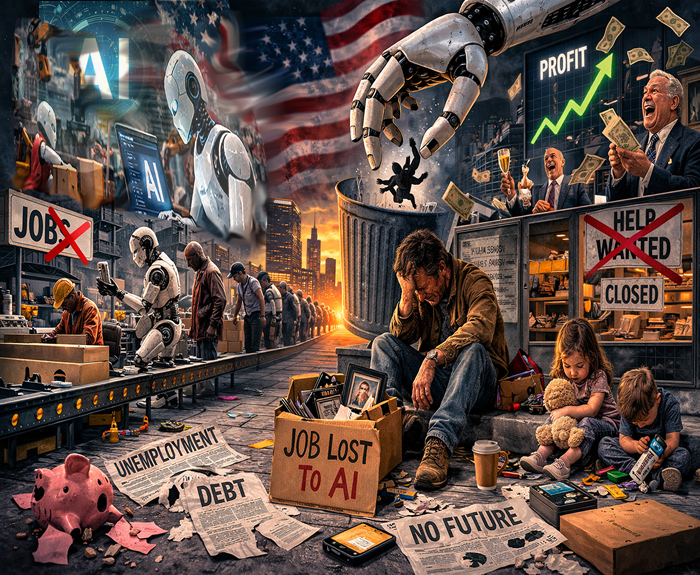
The displacement isn't accidental. The cruelty isn't incidental. And the silence is deafening.
By DCXpress News Staff Writer ftb | Opinion
“Congratulations on your years of service. By the way, your county taxes just went up. Gas is a dollar more a gallon. Your health insurance? Gone — yours and your kids’. Rent? Good luck with that. Oh, and Mom’s in a nursing home so there’s no falling back on family. But hey — the Q3 numbers look fantastic. Thanks for everything you did to make this company profitable. Later.”
Nobody actually says it like that. They never do. Instead, you get a carefully worded HR email, a 60-day WARN Act notice if you’re lucky, and a LinkedIn post from the CEO about “evolving toward a more agile, AI-enabled future.” But strip away the corporate language and what’s left is exactly that: Later, sucker.
This is the story American media keeps failing to tell — not because it’s hard to find, but because the people telling the stories are largely insulated from the pain.
The Bias Built Into the Narrative
Every week another think tank publishes a report on which white collar jobs AI will eliminate next. Lawyers. Accountants. Financial analysts. Radiologists. The coverage is breathless, the hand-wringing extensive.
Meanwhile, the warehouse worker being replaced by an Amazon fulfillment robot gets a footnote. The truck driver staring down autonomous freight gets a paragraph. The machinist whose entire plant digitized overnight gets nothing.
The reason is not complicated: AI displacement coverage is written by white collar people, for white collar people. The data models used to measure “occupational AI exposure” lean heavily on cognitive task descriptions — the kind of work that office workers do. Physical labor, skilled trades, and dexterous work get underweighted, even as robotics and AI-assisted tools advance aggressively into those fields.
But here’s what’s actually happening on the ground: crawl bots mapping pipe systems before a plumber ever puts on his knee pads. AI-interfaced camera systems feeding structural data to fire commanders in real time. Autonomous harvesters. Robotic welding arms pushing into custom fabrication. The trades aren’t safe — they’re just not being watched.
The Identity They’re Not Just Losing a Job
For most Americans, work is not merely a paycheck. It is identity. The machinist is not a man who operates machinery — he is a machinist. The paralegal, the claims adjuster, the dispatcher, the route driver — these are not job titles. They are self-definitions built over decades of showing up, solving problems, and taking pride in competence.
When AI eliminates that role, it does not just eliminate a source of income. It strips the self. And for a generation of workers who built their entire identity around not needing a handout — who took profound pride in self-sufficiency — the psychological damage runs deep and quiet.
They will not go to the unemployment office. Not because the need isn’t there, but because this government has made that process deliberately humiliating and nearly inaccessible. They would rather suffer in silence than surrender the last piece of dignity they have left.
The Real Freeloaders in the Room
There is a word that gets thrown around in political discourse for people who take without contributing: freeloaders. It is almost never applied to the corporations capturing the productivity gains of AI while simultaneously shedding the workforce that built their profits.
Let us be precise about what is happening: A company automates 30% of its workforce. Revenues hold or increase. Executive compensation rises. Stock price climbs. The displaced workers — whose institutional knowledge, reliability, and labor created the conditions for that profitability — receive a severance package, a COBRA notice, and a best-of-luck.
Meanwhile, the cost of their displacement — the unemployment (if you can navigate it), the Medicaid applications, the food assistance, the community mental health burden — is absorbed by the public, if it exists at all. The government has stripped these programs bare at the exact moment they are needed most. No help from Uncle Sam, he has got his finger in another pie. The company privatizes the gain and socializes the damage — into a safety net full of holes.
If that is not freeloading, the word has no meaning.
A Nation of What, Exactly?
This is not a screed against technology. AI has genuine capacity to augment workers rather than simply replace them — the firefighter with an AI-analyzed thermal feed making better life-or-death decisions, the technician arriving at a job site already briefed by a diagnostic crawl bot. The question has never been whether AI is capable. The question is who captures the value and who absorbs the cost.
Right now, the answer is unambiguous. Capital captures the value. Workers absorb the cost. And a government that has systematically dismantled safety net infrastructure, made benefit access an exercise in humiliation, and offered no serious retraining architecture is not a neutral bystander. It is an accomplice.
If tens of millions of skilled, experienced, proud Americans are pushed out of the workforce with no viable path back in — what does this country look like in ten years? Not a hypothetical. A trajectory.
The workers who built the profits that funded the AI that replaced them are not going to hold a sign outside headquarters. They’re going to sit quietly at a kitchen table, staring at a stack of bills, too proud to ask for help and too exhausted to fight.
That silence is not acceptance. It is a pressure building with nowhere to go.
Someone should probably pay attention to that.
DCXpress.news — Independent Editorial. No filters. No handlers.
By DCXpress News Staff Writer ftb | Opinion
“Congratulations on your years of service. By the way, your county taxes just went up. Gas is a dollar more a gallon. Your health insurance? Gone — yours and your kids’. Rent? Good luck with that. Oh, and Mom’s in a nursing home so there’s no falling back on family. But hey — the Q3 numbers look fantastic. Thanks for everything you did to make this company profitable. Later.”
Nobody actually says it like that. They never do. Instead, you get a carefully worded HR email, a 60-day WARN Act notice if you’re lucky, and a LinkedIn post from the CEO about “evolving toward a more agile, AI-enabled future.” But strip away the corporate language and what’s left is exactly that: Later, sucker.
This is the story American media keeps failing to tell — not because it’s hard to find, but because the people telling the stories are largely insulated from the pain.
The Bias Built Into the Narrative
Every week another think tank publishes a report on which white collar jobs AI will eliminate next. Lawyers. Accountants. Financial analysts. Radiologists. The coverage is breathless, the hand-wringing extensive.
Meanwhile, the warehouse worker being replaced by an Amazon fulfillment robot gets a footnote. The truck driver staring down autonomous freight gets a paragraph. The machinist whose entire plant digitized overnight gets nothing.
The reason is not complicated: AI displacement coverage is written by white collar people, for white collar people. The data models used to measure “occupational AI exposure” lean heavily on cognitive task descriptions — the kind of work that office workers do. Physical labor, skilled trades, and dexterous work get underweighted, even as robotics and AI-assisted tools advance aggressively into those fields.
But here’s what’s actually happening on the ground: crawl bots mapping pipe systems before a plumber ever puts on his knee pads. AI-interfaced camera systems feeding structural data to fire commanders in real time. Autonomous harvesters. Robotic welding arms pushing into custom fabrication. The trades aren’t safe — they’re just not being watched.
The Identity They’re Not Just Losing a Job
For most Americans, work is not merely a paycheck. It is identity. The machinist is not a man who operates machinery — he is a machinist. The paralegal, the claims adjuster, the dispatcher, the route driver — these are not job titles. They are self-definitions built over decades of showing up, solving problems, and taking pride in competence.
When AI eliminates that role, it does not just eliminate a source of income. It strips the self. And for a generation of workers who built their entire identity around not needing a handout — who took profound pride in self-sufficiency — the psychological damage runs deep and quiet.
They will not go to the unemployment office. Not because the need isn’t there, but because this government has made that process deliberately humiliating and nearly inaccessible. They would rather suffer in silence than surrender the last piece of dignity they have left.
The Real Freeloaders in the Room
There is a word that gets thrown around in political discourse for people who take without contributing: freeloaders. It is almost never applied to the corporations capturing the productivity gains of AI while simultaneously shedding the workforce that built their profits.
Let us be precise about what is happening: A company automates 30% of its workforce. Revenues hold or increase. Executive compensation rises. Stock price climbs. The displaced workers — whose institutional knowledge, reliability, and labor created the conditions for that profitability — receive a severance package, a COBRA notice, and a best-of-luck.
Meanwhile, the cost of their displacement — the unemployment (if you can navigate it), the Medicaid applications, the food assistance, the community mental health burden — is absorbed by the public, if it exists at all. The government has stripped these programs bare at the exact moment they are needed most. No help from Uncle Sam, he has got his finger in another pie. The company privatizes the gain and socializes the damage — into a safety net full of holes.
If that is not freeloading, the word has no meaning.
A Nation of What, Exactly?
This is not a screed against technology. AI has genuine capacity to augment workers rather than simply replace them — the firefighter with an AI-analyzed thermal feed making better life-or-death decisions, the technician arriving at a job site already briefed by a diagnostic crawl bot. The question has never been whether AI is capable. The question is who captures the value and who absorbs the cost.
Right now, the answer is unambiguous. Capital captures the value. Workers absorb the cost. And a government that has systematically dismantled safety net infrastructure, made benefit access an exercise in humiliation, and offered no serious retraining architecture is not a neutral bystander. It is an accomplice.
If tens of millions of skilled, experienced, proud Americans are pushed out of the workforce with no viable path back in — what does this country look like in ten years? Not a hypothetical. A trajectory.
The workers who built the profits that funded the AI that replaced them are not going to hold a sign outside headquarters. They’re going to sit quietly at a kitchen table, staring at a stack of bills, too proud to ask for help and too exhausted to fight.
That silence is not acceptance. It is a pressure building with nowhere to go.
Someone should probably pay attention to that.
DCXpress.news — Independent Editorial. No filters. No handlers.
Login or Register to leave a comment.
Comments
No comments yet.